User Interviews is a research-recruiting platform. Companies and researchers use it to find real people for paid interviews, focus groups, usability tests, surveys and other studies. Joining as a participant is free. You apply to studies that fit you, and you earn an incentive once you complete an accepted session.
This guide is written for participants, since that is the side most readers of Remotesme will use. It covers the profile, applying, screeners, the session, and getting paid, and it ends with a short note for researchers.
How User Interviews works
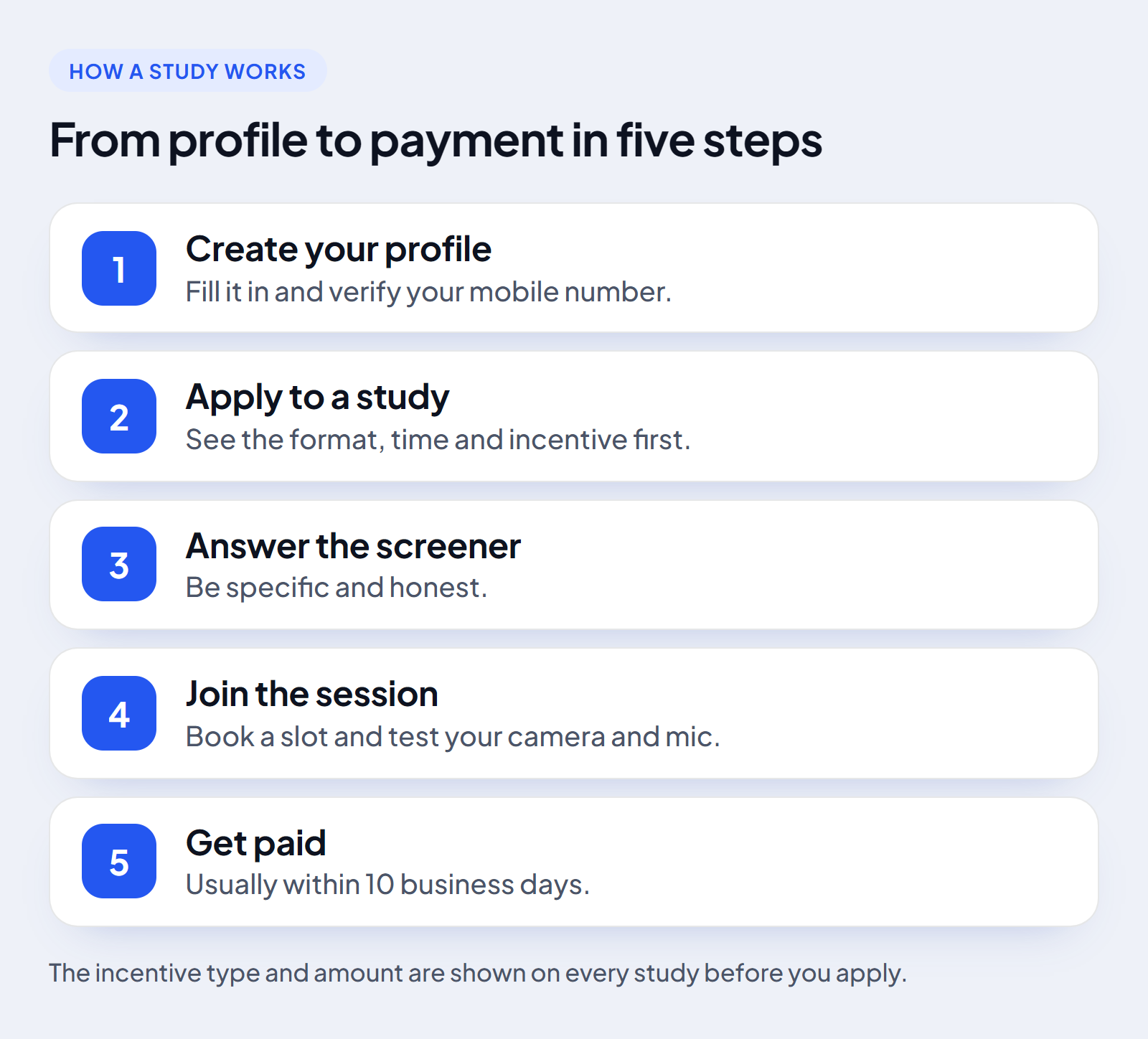
Researchers post a study with clear requirements. These can be an age range, a location, a job title, the software you use, how you shop, or your professional background. You create a profile, browse the open studies and apply to the ones that match you.
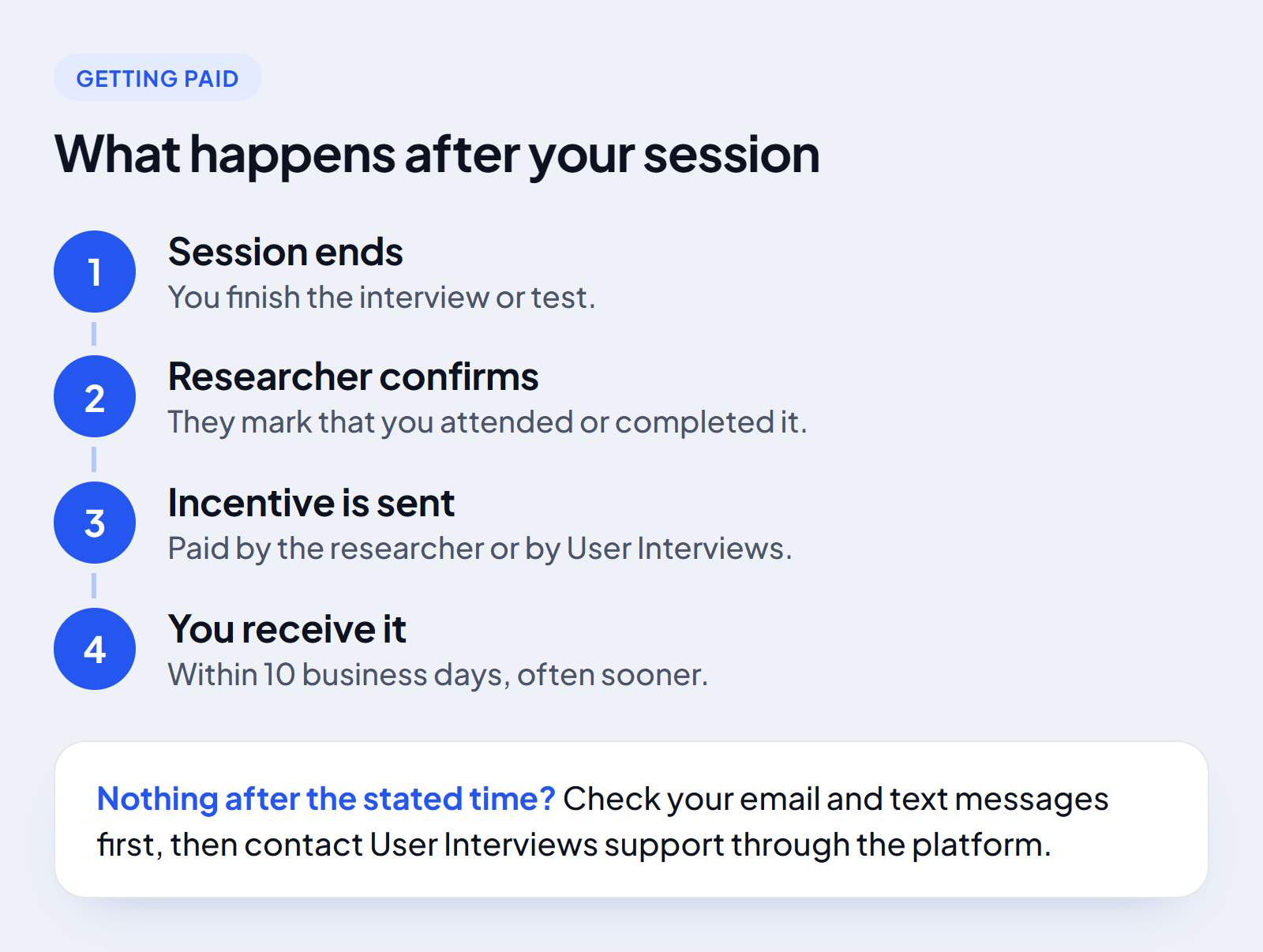
If a researcher picks you, you take part in the session and receive the incentive listed on the study. The incentive type and amount are shown before you apply. User Interviews says payment usually goes out within 10 business days after a successful session, and often sooner.
Create your participant profile
Make an account, fill in the profile completely, and verify a mobile phone number. User Interviews uses the profile to match you with relevant studies and uses text messages for updates and reminders.
A complete profile gets you matched more often. Add accurate details about:
- Your age range and where you live.
- Your employment status and job title.
- The industries you have worked in.
- The software, apps and devices you use.
- Your habits around shopping, finance, health, travel or technology.
- Your professional skills and areas of expertise.
Do not stretch the truth or guess just to qualify for more studies. Screeners are built to filter out poor matches, and researchers can rate the quality of participants after a session.
Apply to studies
Once your profile is active, browse the paid studies page and apply to listings that match your real experience. Each listing shows the study format, how long it takes, the incentive amount and the incentive type before you apply.
Studies come in several formats:
- One-on-one online interviews.
- In-person interviews or focus groups.
- Phone interviews.
- Website or app usability tests.
- Diary studies.
- Surveys and unmoderated research tasks.
Read the requirements before you apply. If a study wants people who use a certain tool every week, hold a specific job title or live in a particular area, apply only if that description honestly fits you.
Screeners and how you get selected
A screener is a short survey you answer before the study. It helps the researcher decide whether you fit. Expect multiple choice, short answers and some open-ended questions.
Researchers often add what they call articulation questions, which test whether you can explain your own experience clearly. Instead of only asking whether you use a budgeting app, a researcher may ask you to describe the last time you used one and what you liked or disliked about it.
To improve your chances:
- Answer every question honestly.
- Write full sentences when an open answer is requested.
- Give specific examples instead of one-word replies.
- Follow the screener's instructions exactly.
- Skip studies you do not qualify for.
- Check your email and text messages often after applying.
What happens after you are selected
You will get scheduling options based on the researcher's availability. User Interviews has built-in scheduling, so you pick an open time slot, receive reminders, and join through the link or location details provided.
For an online session, arrive a few minutes early, test your camera and microphone, and find a quiet space. For an in-person study, confirm the address, the parking or transit options and your arrival time ahead of time.
In the session, researchers usually want honest opinions, not flattering ones. Speak clearly, explain your reasoning, and say so when you are unsure. They are trying to learn how real people think and act, so you do not need perfect answers.
A sample study and its screener
Here is a typical online interview study, made up as an example. The listing reads: topic, online grocery shopping habits. Format, a 45-minute one-on-one video interview. Incentive, a $75 digital gift card. Looking for adults who have ordered groceries online at least once in the past month.
The screener might ask:
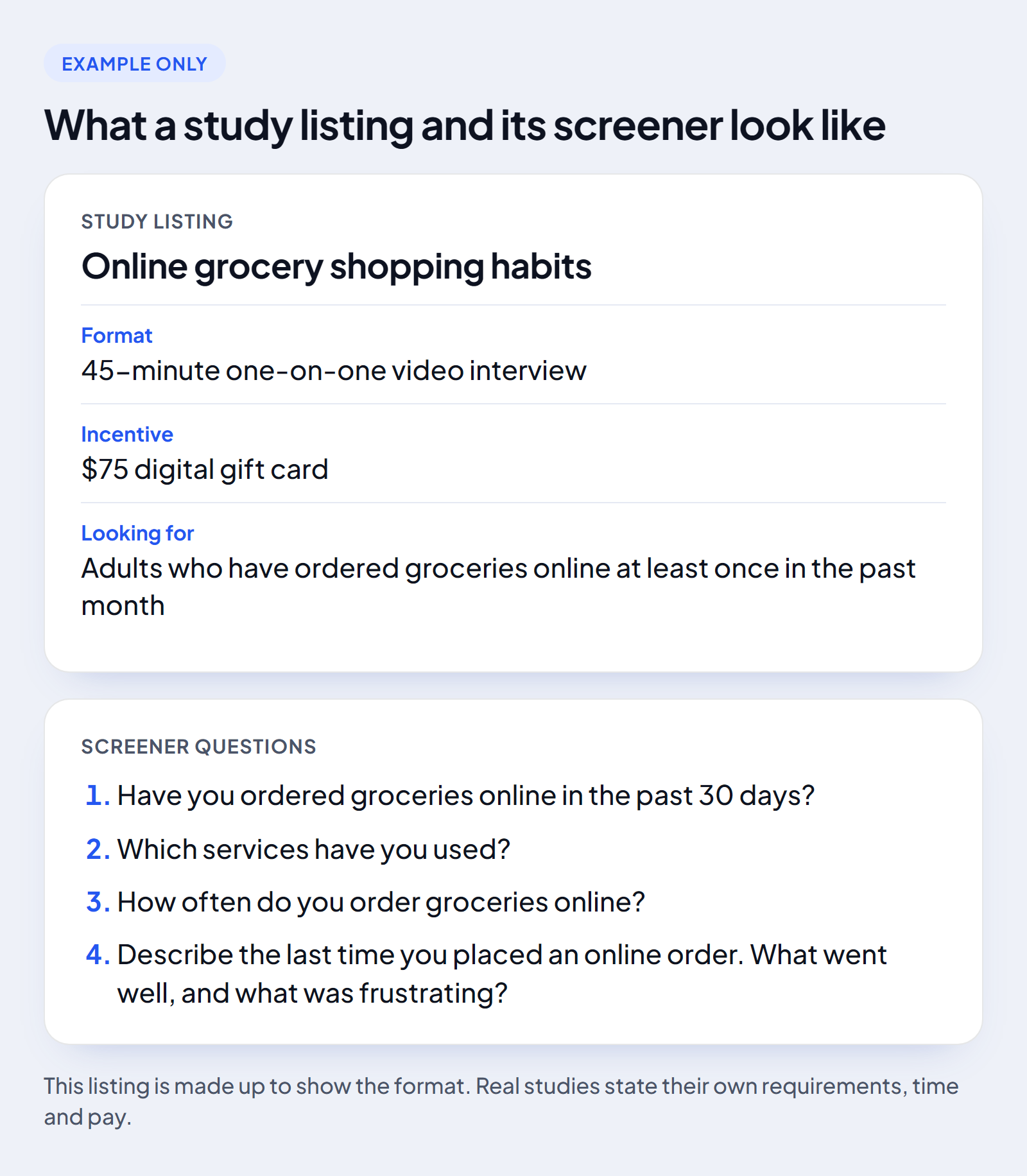
- Have you ordered groceries online in the past 30 days?
- Which services have you used?
- How often do you order groceries online?
- Describe the last time you placed an online grocery order. What went well, and what was frustrating?
A strong answer and a weak one
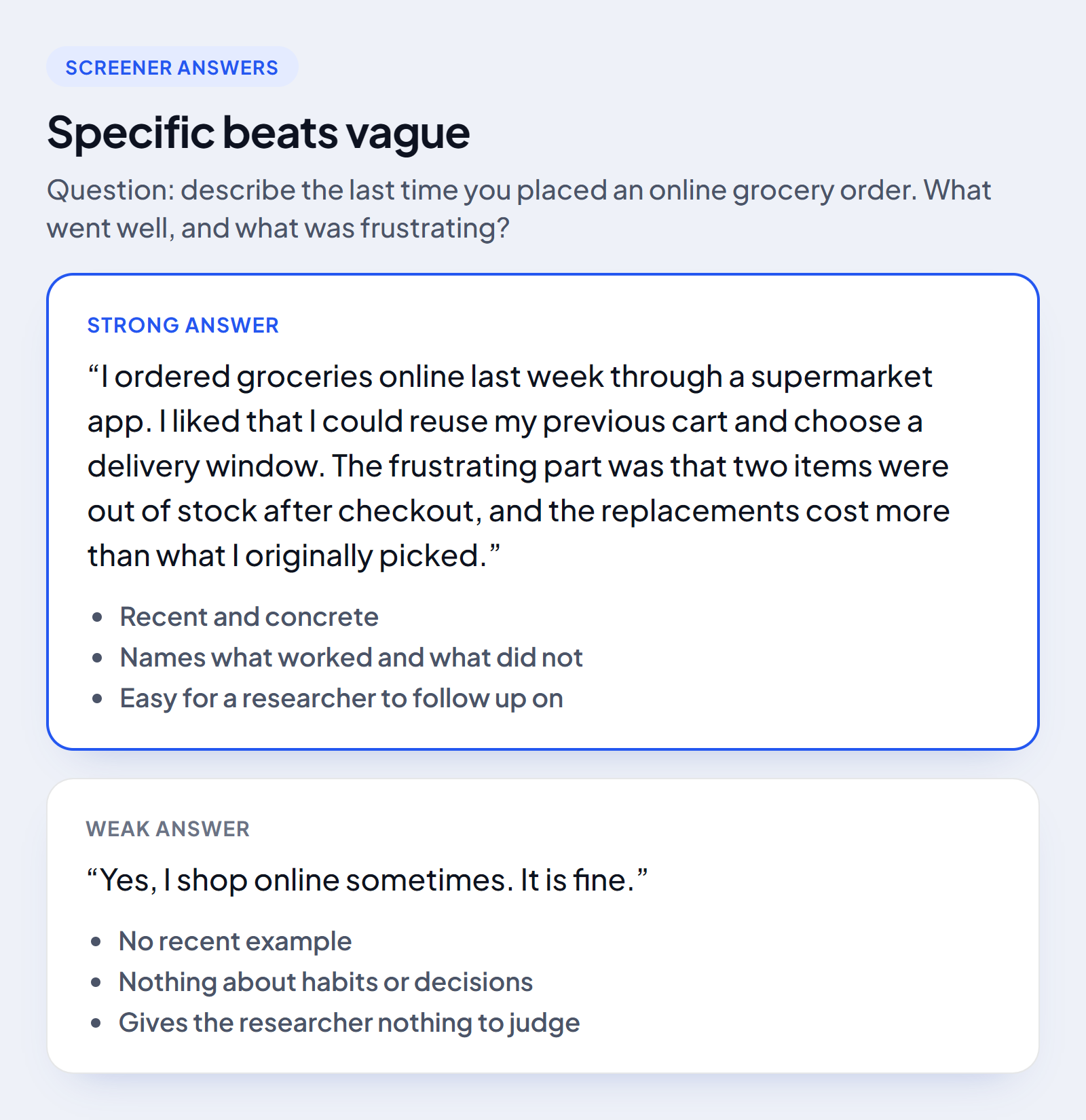
A strong answer to that last question could be: "I ordered groceries online last week through a supermarket app. I liked that I could reuse my previous cart and choose a delivery window. The frustrating part was that two items were out of stock after checkout, and the replacements the app suggested cost more than what I originally picked."
That answer works because it is specific, honest and easy for a researcher to follow up on.
A weak answer would be: "Yes, I shop online sometimes. It is fine." It is too vague. It shows no recent experience, says nothing about your habits, and gives the researcher nothing useful to judge.
Example interview questions
In the session, a researcher might ask:
- Walk me through the last time you ordered groceries online.
- What made you choose that service?
- What almost stopped you from completing the order?
- How do you decide between delivery and pickup?
- What would make you use the service more often?
- If you could change one thing about the experience, what would it be?
Good participants give concrete examples, describe how they actually decided, and avoid guessing what the researcher wants to hear.
Getting paid
You see the incentive before you apply. After you finish a session, the researcher marks that you attended or completed it, and the incentive is sent. User Interviews says incentives are paid within 10 business days, though many are processed sooner.
Researchers can send incentives themselves or let User Interviews handle it automatically. With automatic payments, participants can choose from many digital gift card options.
Watch your email and text messages after the session. If your reward link has not arrived within the stated time, contact User Interviews support through the platform.
If you are a researcher
Researchers start by defining the study goal, the audience, the session format and the incentive. User Interviews provides tools for recruiting criteria, screeners, scheduling, messaging, consent, incentives and analysis. It offers two main routes: Recruit, which draws on its participant panel, and Research Hub, which lets a team manage and re-engage its own panel.
A good screener is short, neutral and focused on the traits that matter. Avoid leading questions. Instead of asking "Do you agree that our new checkout process is easy to use?", ask "Describe the last time you completed an online checkout. What worked well, and what was difficult?" The second version does not push people toward a positive answer, so the data is more useful. User Interviews also recommends paying incentives as soon as possible after a session ends.
Pricing for researchers changes, so check the User Interviews pricing page if you are planning a study.
Tips for better results
- Keep your profile current.
- Apply only to studies that match your real experience.
- Write detailed, specific screener answers.
- Show up on time and test your equipment.
- Speak honestly and give examples.
- Follow instructions exactly.
- Do not no-show, because repeated cancellations can hurt your chances at future studies.
A short checklist
- Create a complete profile.
- Verify your phone number.
- Read every study description and screener carefully.
- Apply only when you genuinely match the requirements.
- Give specific, honest answers.
- Prepare a quiet space and test your camera and microphone.
- Arrive early for scheduled sessions.
- Follow up if an incentive does not arrive in the stated period.
User Interviews works best when both sides take it seriously. Participants who give clear, honest feedback are more likely to be picked again, and researchers who write focused screeners and pay promptly tend to get better sessions.
To see how User Interviews works and to join, visit the User Interviews platform page. The sign-up link there is a referral link, which costs you nothing and does not change what you are paid.