micro1 matches remote contractors with AI-training projects: rating AI responses, annotating data, writing prompts, research, coding, reviewing images and video, and expert work in specific fields. Most roles do not ask for earlier AI-training experience. What they do reward is careful judgment, clear writing, and the discipline to follow a project rubric exactly.
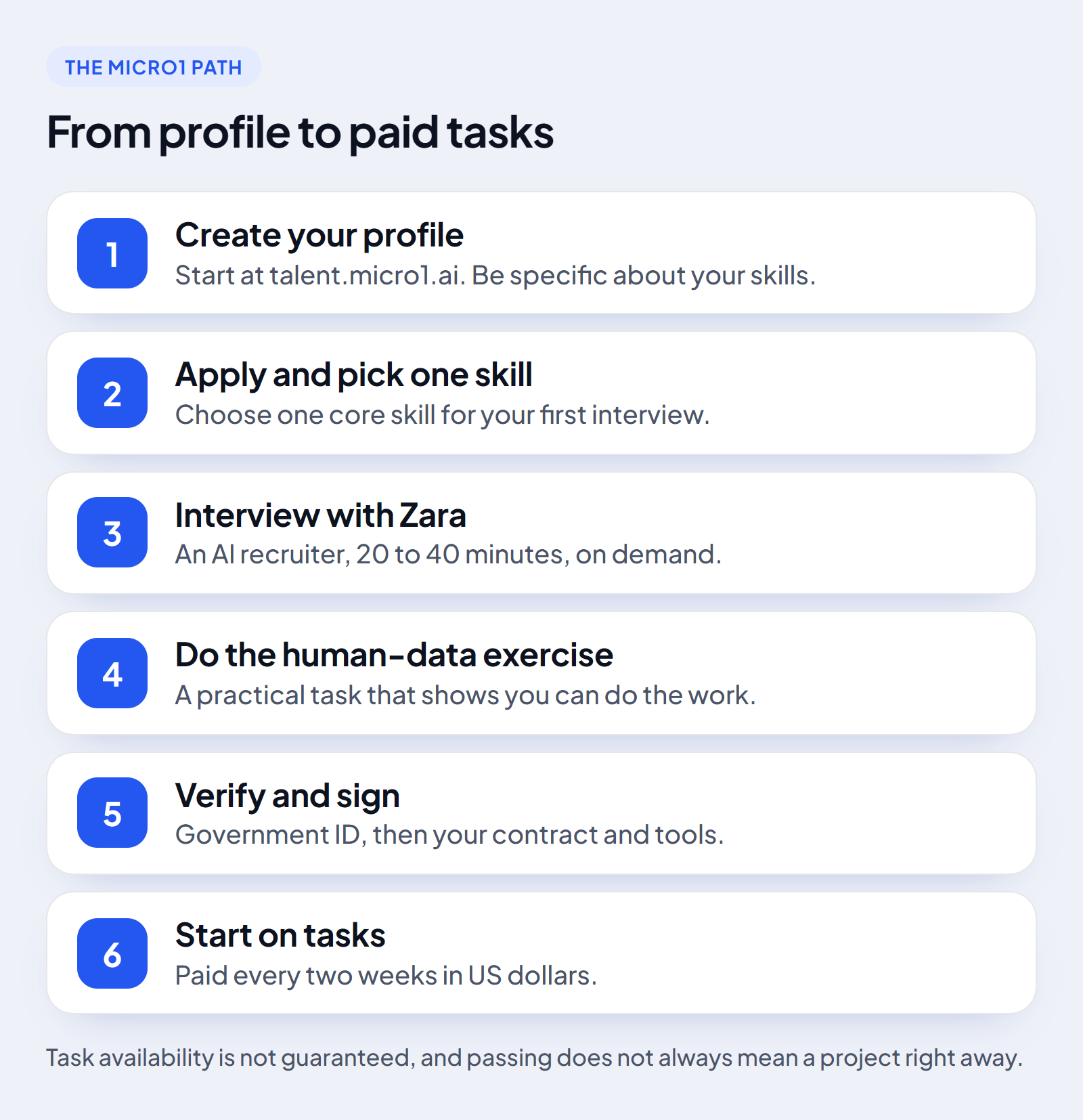
This guide walks through the usual path. You make a profile, apply, interview with micro1's AI recruiter, do a practical exercise, get verified, and then start on tasks. It also shows what image evaluation work looks like, since that is one of the most common entry points.
Create your profile
Most people begin in micro1's expert portal at talent.micro1.ai, though you can also browse openings on the company's Opportunities Portal. List your skills, work history, education and the kind of AI-training work you want.
A specific profile does better than a vague one. "Reviewed AI outputs" says almost nothing. "Evaluated AI-generated images for prompt adherence, visual quality, anatomy, composition, artifacts and instruction following" shows micro1 exactly what you are good at.
Skill areas you will see on micro1 include:
- AI response evaluation
- Search and webpage quality
- Data annotation
- Technical research
- Content review and editing
- Cybersecurity subject-matter work
- AI image and video evaluation
- Generalist AI training
- Coding tasks
Apply to the right opportunities
You can browse open roles and apply to the ones that fit your experience. Once your profile is active, micro1 may also invite you directly when your verified skills match a project that needs people.
You can apply to several roles, but pick one core skill or job type for your first AI interview. micro1 judges you against the role and skill area you choose, so a focused application is easier to prepare for and usually comes across as stronger.
For image work, look for listings such as Image Evaluation Generalist, AI Image and Video Evaluation Specialist, and multimodal evaluation roles. These projects center on comparing generated images, spotting visual flaws, and explaining your decisions clearly.
Take the Zara AI interview
Every applicant interviews with Zara, micro1's AI recruiter. Zara asks questions tied to the role, writes a transcript, and produces an assessment from your answers.
The interview is available on demand and usually lasts 20 to 40 minutes. The questions can branch in real time depending on how you answer, so two people applying for the same role may not hear the same set.
What Zara looks at
Zara assesses communication, reasoning and skills for the role. Depending on the job, you might get open technical questions, scenario questions, a coding challenge or a human-data exercise. Expect questions in these groups:
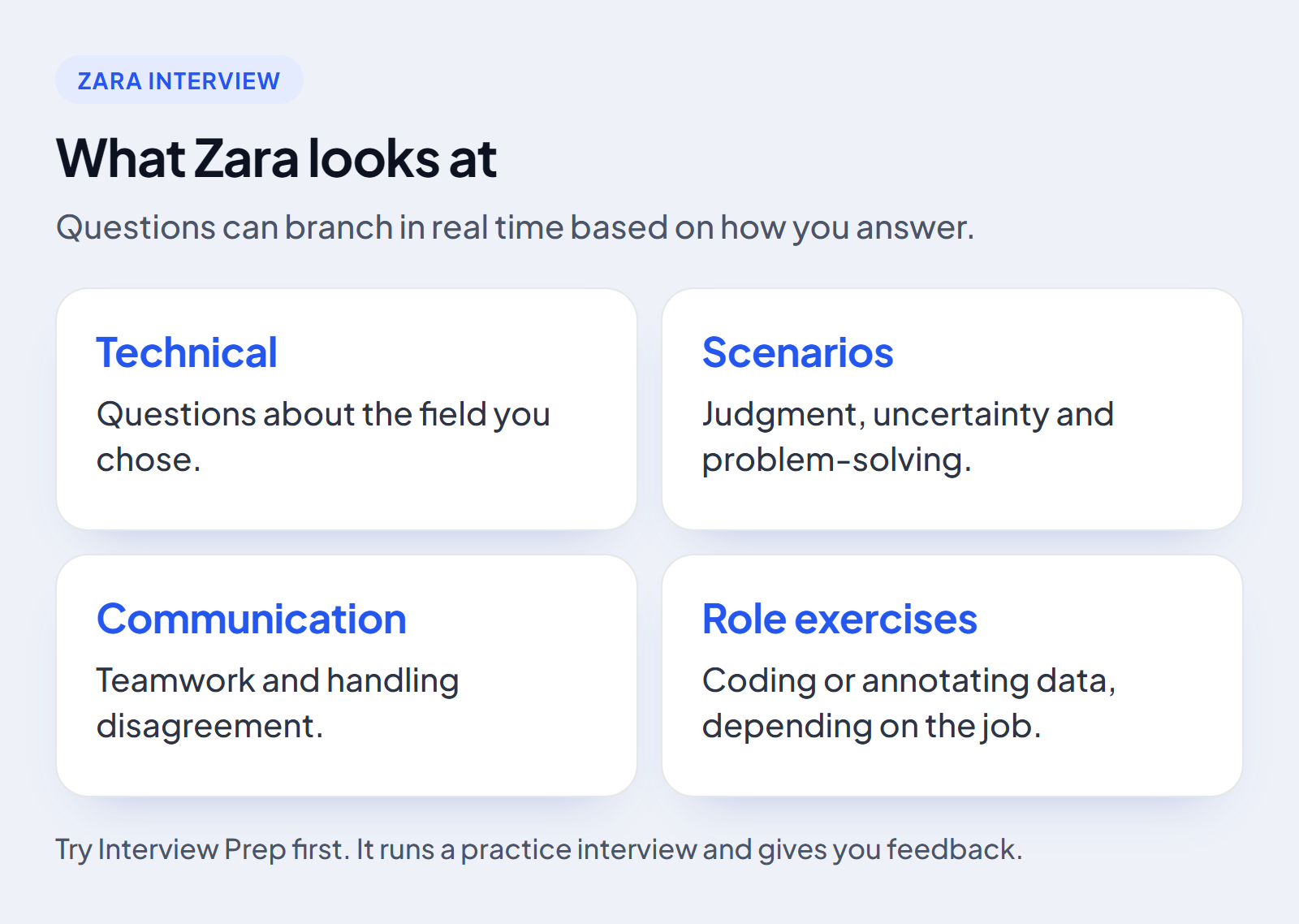
- Technical questions about the field you chose.
- Scenarios about judgment, uncertainty and problem-solving.
- Questions about communication, teamwork and handling disagreement.
- Role-specific exercises, such as coding or annotating data.
Scenario questions can sound like this: how do you manage uncertainty when you have to make a decision? Describe a time you disagreed with a teammate and how you handled it. Tell me about a project where communication broke down.
Practice with Interview Prep first
micro1 has an Interview Prep tool. It runs an AI practice interview and gives you feedback, which helps you get comfortable speaking clearly on camera and answering in an organized way.
Before the real interview:
- Choose one core skill or job type.
- Find a quiet room with a stable internet connection.
- Keep your camera on.
- Treat it like a real professional interview.
- Answer directly, explain your reasoning, and do not ramble.
You get a result in real time that shows whether you meet micro1's global certification criteria. If you do not pass, you can ask for feedback and apply to other roles.
Do the human-data exercise
For annotation and evaluation roles, the interview may include a Human Data Exercise. It is a practical task that shows whether you can do the actual work: applying a rubric, scoring sample outputs, sorting information into categories, or judging AI-generated content.
For image roles, the exercise might ask you to compare image outputs, find visual errors, check prompt adherence, or write a short review of which image is better and why.
Before you start an exercise:
- Read the instructions all the way through before answering.
- Find the rating scale or output format it wants.
- Check whether it asks for a choice, a ranking, a rewrite, an explanation or a citation.
- Reread your answers for clarity, completeness and instruction following.
- Do not submit until every required field is filled in.
Get verified and onboarded
If you pass, micro1 asks you to verify your identity with a government-issued ID. After that you become a certified micro1 expert, sign a contract, and set up the tools your assigned work needs.
Certified experts are usually updated on their application status within 30 days. If you are not picked for one role, your profile stays active for future openings.
What image evaluation tasks look like
micro1 image projects often have you generate or review images from the same prompt across several AI tools, then compare the results side by side. You judge realism, composition, color, lighting, anatomy, text rendering, coherence and overall visual quality.
Common tasks include:
- Comparing two or more AI-generated images.
- Rating how well each follows the prompt.
- Spotting artifacts, warped anatomy, extra limbs, inconsistent lighting or unreadable text.
- Checking that an image matches the requested style, subject, setting and mood.
- Writing a short explanation of the strengths, the weaknesses and your ranking.
- Flagging edge cases or patterns that the project guidelines do not clearly cover.
A sample image task, rated
Here is a realistic example of a generalist image task.
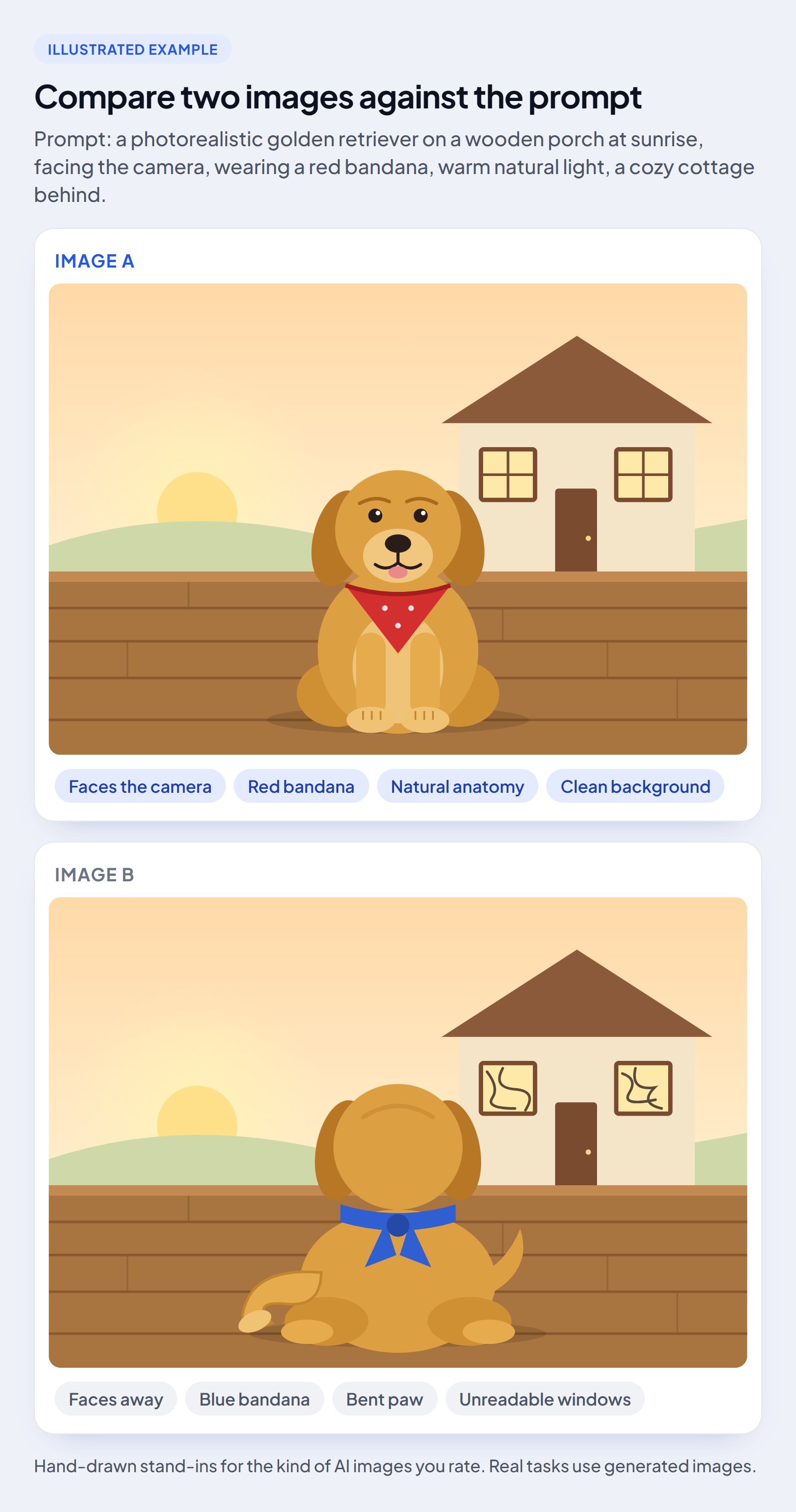
The prompt reads: "Create a photorealistic image of a golden retriever sitting on a wooden porch at sunrise. The dog should be facing the camera, wearing a red bandana, with warm natural light and a cozy cottage in the background."
Image A shows a golden retriever facing the camera on a wooden porch, wearing a red bandana. The sunrise light is warm and the cottage is visible behind the dog. The fur, eyes, paws and bandana look natural, the composition is clean, and there are no obvious defects.
Image B shows a golden retriever on a porch at sunrise, but the dog faces away from the camera and the bandana is blue instead of red. One front paw bends unnaturally, and the cottage windows hold distorted shapes you cannot read. The lighting is pleasant, but several requirements from the prompt are missing.
Image A is strong on prompt adherence, subject accuracy, anatomy, background detail and overall quality. Image B is weak on prompt adherence, anatomy, background detail and overall quality, only partly right on the subject, and strong on lighting and realism.
A written justification could read: "Image A is stronger because it meets the main requirements of the prompt. The golden retriever faces the camera, wears a red bandana, and sits on a wooden porch in warm sunrise light with a cottage behind it. Its anatomy, fur and overall realism are consistent. Image B has attractive lighting but misses several explicit requirements: the dog faces away, the bandana is blue instead of red, one paw looks distorted, and the cottage windows show unnatural shapes. Image A is the better output overall."
Why precision matters
Precision is central to micro1 work. The company says strong candidates follow rubrics closely, stay consistent from task to task, and explain their reasoning clearly. Its image roles specifically ask reviewers to catch visual inconsistencies, document errors and write brief explanations for their calls.
To keep your quality up:
- Read the whole prompt before you look at the images.
- Check every requested element: subject, action, clothing, setting, lighting, style and composition.
- Keep personal taste separate from prompt adherence.
- Look closely at hands, paws, faces, eyes, text, reflections and background objects.
- Decide whether each problem is major or minor.
- Use the exact rating definitions in the rubric.
- Write specific justifications, not vague comments.
- Hold similar images to the same standard.
An image can be beautiful and still fail because it misses the subject, color, pose or setting that was asked for. Another can follow the prompt and still lose points for distorted anatomy or obvious artifacts. Precision means catching both kinds of problem and scoring each one by the rubric.
Pay, flexibility and what to expect
micro1 describes AI-training work as remote and self-directed, with tasks finished within project deadlines. Pay depends on the project, your skill level and your verification level, and each role lists its pay when you apply.
micro1 publishes these ranges by type of work:
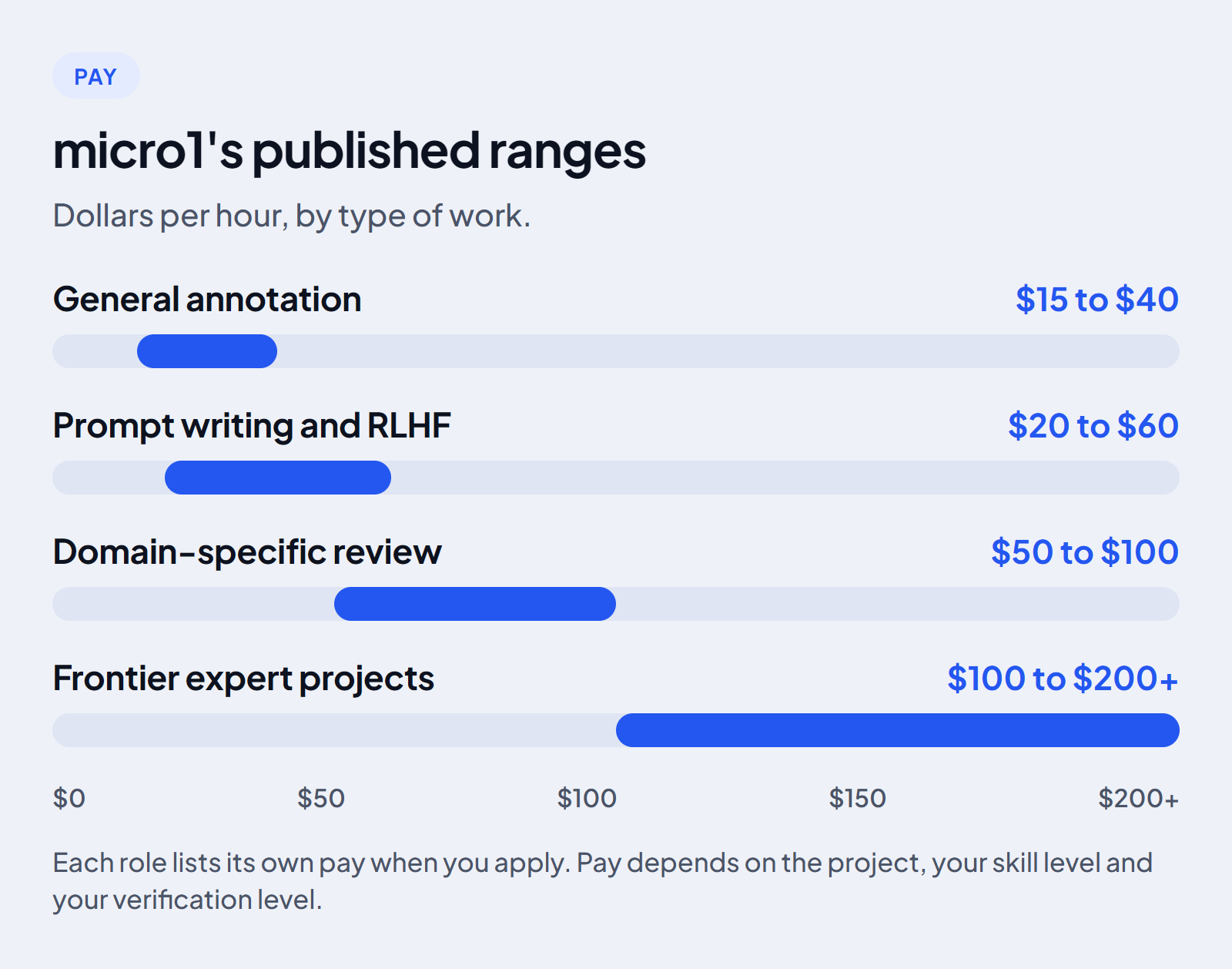
- General annotation, such as tagging content, ranking responses and A/B comparisons: $15 to $40 per hour.
- Prompt writing and RLHF evaluation, meaning prompts and structured feedback on AI outputs: $20 to $60 per hour.
- Domain-specific review, which is expert checking in medicine, law, engineering or code: $50 to $100 per hour.
- Frontier expert projects for verified specialists on sensitive, high-stakes research: $100 to $200 or more per hour.
Image evaluation listings may sit in the generalist range. One public micro1 listing for an Image Evaluation Generalist advertises $20 to $30 per hour.
Payments are processed every two weeks in US dollars. Task availability is not guaranteed, and passing the interview does not always mean a project comes right away.
A short checklist
- Write a specific, honest profile.
- Apply to roles that match your real skills.
- Choose one core skill for your first Zara interview.
- Use Interview Prep before the real interview.
- Prepare clear examples about judgment, accuracy and communication.
- Read human-data exercise instructions carefully.
- Follow the rubric exactly.
- Check every requirement in an image prompt.
- Look for problems with anatomy, text, lighting, composition and artifacts.
- Give specific written reasons for your ratings.
- Verify your identity promptly after you pass.
- Build a strong early quality record before you chase higher-paying projects.
The contractors who do best on micro1 are usually careful rather than fast. They read the whole task, apply the rubric the same way each time, explain their decisions clearly, and avoid careless mistakes.
To see how micro1 works and what is open right now, visit the micro1 platform page. The apply link there is a referral link, which costs you nothing and does not change what you are paid.